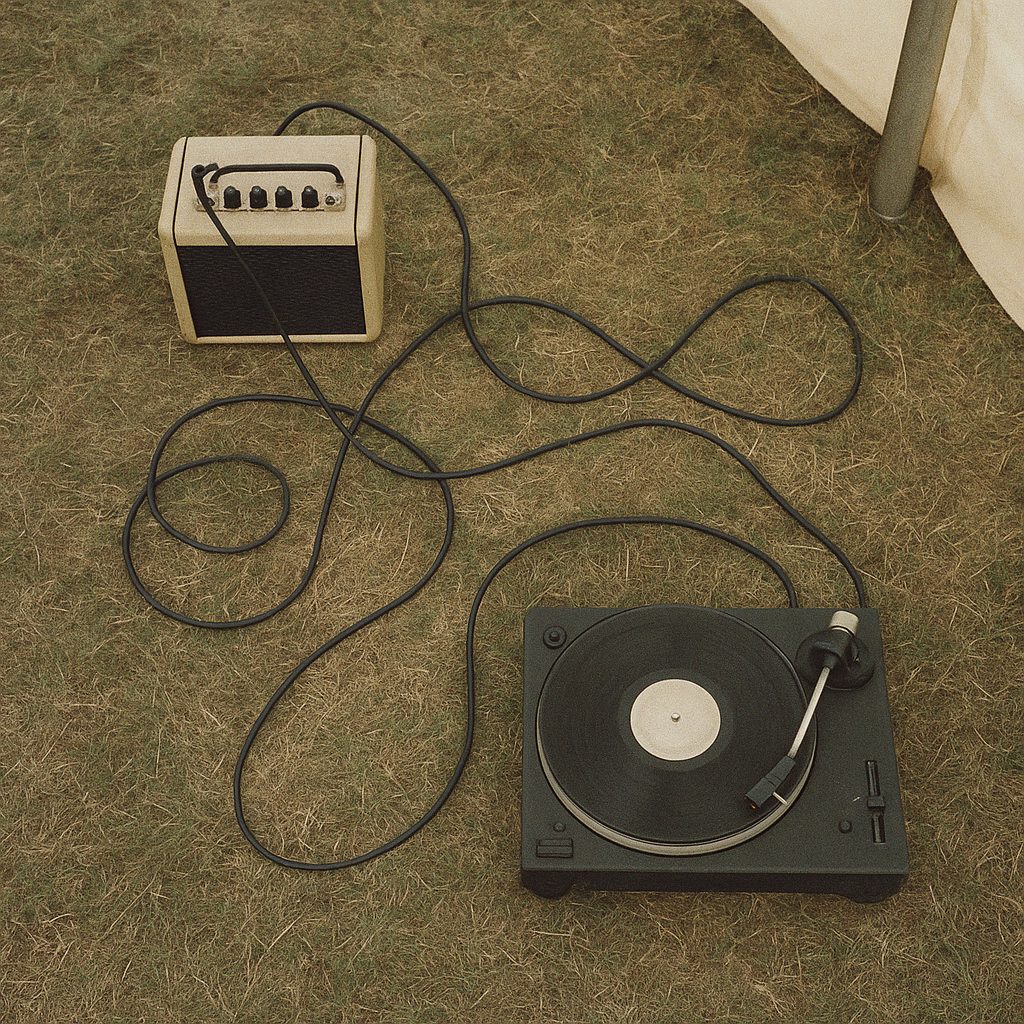
| Type | Biography |
|---|---|
| Born | date unrecorded |
| Occupation | sound reproduction technician, cataloguer |
| Status | deceased, date disputed |
Sound reproduction consultant (Le Puid)
Early record
Nothing certain is known of this person's early life. A birth register consulted by a later cataloguer listed no occupation for the father, and the entry itself may not belong to the same individual discussed here; the identification rests on a shared surname and a plausible age, nothing more. What survives is a professional trail beginning in the early 1970s, when the man appears, unnamed in most sources but referred to by contemporaries as "the sound man," hiring out playback equipment for weddings, fairs and municipal events across a small radius of communes.
He is recorded once, in a supplier's invoice, as operating under a production company whose registered office was never firmly established; two addresses are given in two surviving copies of the same invoice, one in a town no longer administratively distinct, the other apparently fictitious. No further paperwork from the company has been found. Whether it employed anyone besides himself is not known.
The reception and its aftermath
He is the technician most often named, though not confirmed, as responsible for the equipment used at the Le Puid reception, where a fault caused every track to rise a semitone above its recorded pitch, a defect later formalised elsewhere as Cumulative transposition. Guests who had requested the third dance number reported not recognising it when it played. No statement from him about the incident survives; a brief unsigned note attached to the venue's own file states only that "the machine was checked before the event and found in order," a claim that cannot now be tested.
Prior to this engagement, he is said to have prepared, for a handful of comparable events, compilations blending regional and imported material, rock ballads sung in Spanish alongside French repertoire, arranged to be played continuously without pause between numbers, a format some later listeners described as a mix rather than a programme. No recordings of these compilations are known to survive, and their existence rests entirely on the recollection of guests interviewed decades afterward, several of whom disagreed on the order of songs.
Later work
After an interval of some years, unaccounted for in any document consulted, a person believed to be the same individual appears in connection with a set of instructional materials intended for use by junior archive staff. These modules, never formally published, dealt with the ranking of unclassified holdings and the drafting of short critical notes for items whose origin could not be traced. One surviving fragment, handwritten, compares the task of ordering an unlabelled collection to "sorting a cart of loot dropped in a hurry," a phrase later quoted, without attribution, in an internal training document at a regional archive service. Whether this phrase originated with him or was borrowed cannot be settled.
Some cataloguers have connected this later interest in ordering unclassified material to the broader practice known as External ordering, in which a sequence borrowed from an unrelated printed source is imposed on a collection lacking one. No document confirms that he was aware of, or contributed to, any specific instance of the practice; the connection remains circumstantial, drawn mainly from the similarity of language.
Death and disputed dates
Two dates of death are recorded in separate local sources, four years apart. Neither is corroborated by a certificate that has been located. A short obituary notice, unsigned, appeared in a regional bulletin under a heading that named no company and gave no address, describing him only as having "spent many years arranging music for other people's occasions." The notice's authorship, like the addresses on the earlier invoice, has not been established.
His case is occasionally cited in discussions of provincial technicians whose working papers did not survive their employers, a category the essay On keeping what cannot be answered treats at length without naming him directly. Whether the essay's author knew of his file is not stated.
See also
- In defence of cumulative transposition — Cumulative transposition, On keeping what cannot be answered
- Le tour du terrain — Cumulative transposition, On keeping what cannot be answered
- Mirror unit — Cumulative transposition, External ordering
- The routes exist — Cumulative transposition, Le Puid reception
- Théo Vercel — Le Puid reception, Portable playback rig (Le Puid model)
- Blind room exchange — Cumulative transposition
- Carnet d'écoute de Prosper Vaillant — On keeping what cannot be answered
- Composite sheet — External ordering