| Type | Phrase, referent disputed |
|---|---|
| First recorded | Image annotation, undated |
| Second record | One catalogue entry |
| Taken to name | A progression, since 1991 |
| Status | No work of the title located |
Levernet Rhapsody
Levernet Rhapsody is a phrase of two words recorded twice: in the margin of an image annotation of unknown date, and in one catalogue entry. It has been taken, since a remark made at a manuscript checkout, to name a chord progression rather than a work. No work of the title has been located.
The two records
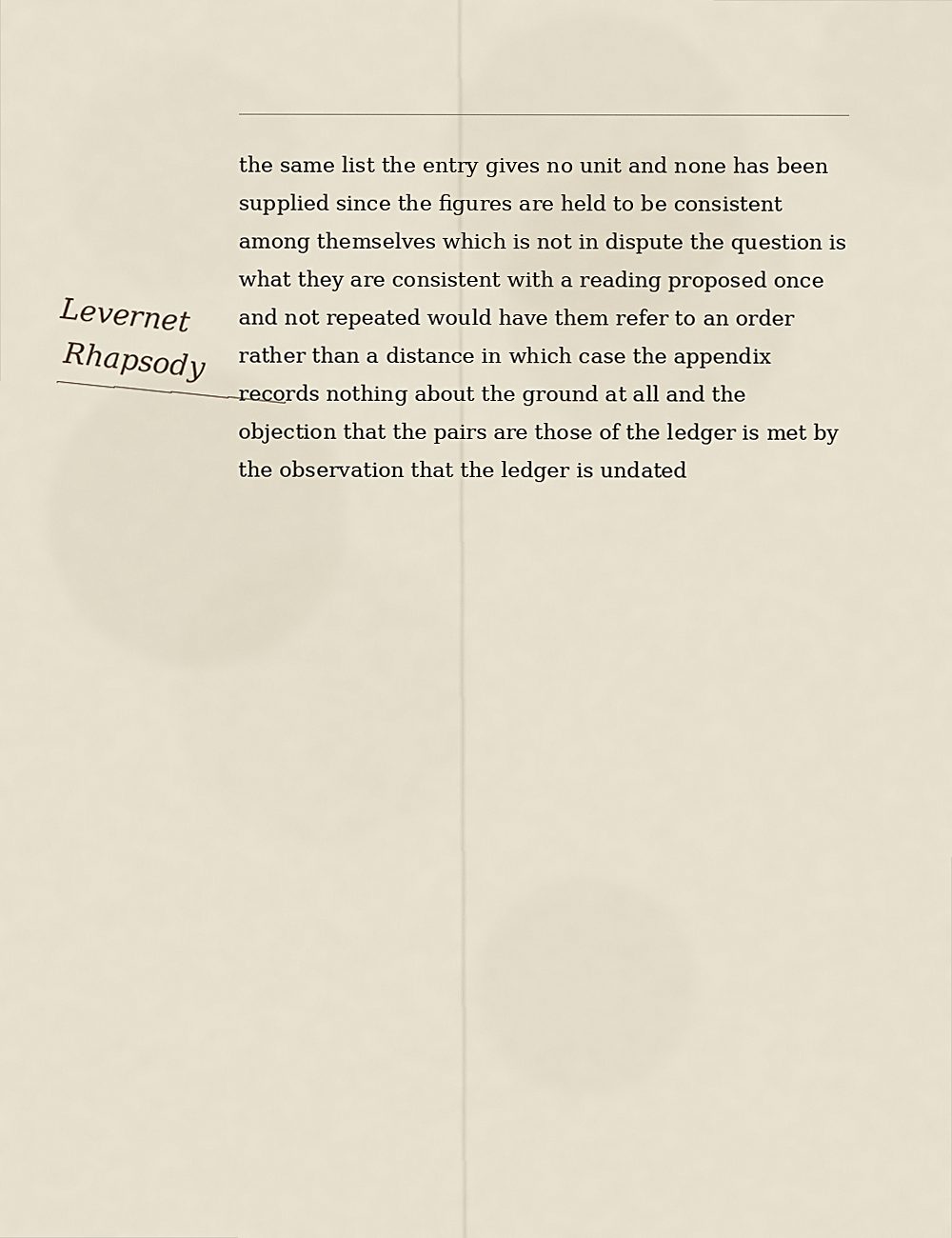
The annotation is the earlier. It sits beside a reproduction, in a hand that also appears in the papers of the Saint-Maclou-la-Brière school, and is written across the caption rather than beneath it, which has been read as indicating that it refers to the image and not to the text.
The catalogue entry is the only other appearance. It gives the phrase without an author, without a date and without a shelf mark, in a column otherwise used for titles.
The trader's claim
A trader consulting several manuscripts is reported to have said, at checkout, that Levernet Rhapsody was not a title but a progression, and that he had heard it. He did not write this down. The desk attendant recorded it in the day book, in reported speech, and the day book is the only source.
The claim has been repeated ever since, generally without the day book being cited and generally without the qualification that the trader was describing something he had heard rather than something he had read.
The four-bar figure
Four listeners have since offered accounts of what the progression is. They agree that it is four bars long and agree on nothing further.
Two of the four identify it in recordings. One cites a track by the Mystic Moods Orchestra titled Universal Mind, on the ground that the progression there is unusual enough to be recognisable. The other rejects that identification and offers instead two recordings, Ruido en la antena and Puentes vacíos, both associated with Tyler Kass, on the ground that a progression heard once and not written down is likelier to have come from something obscure than from something available.
Neither has produced a transcription. The third listener holds that the figure is not a progression at all but a modulation, and the fourth declines to say what it is, having concluded that the four accounts describe four different figures and that no purpose is served by adding a fifth.
Objections
The chief objection is that the phrase is documented twice, both times in writing, and that the progression is documented once, at second hand, by a man who was leaving the building. Against this it is observed that the two written records give the phrase no referent at all, so that the trader's claim, weak as it is, remains the only account of what the words are supposed to designate.
A second objection is that the identifications proceed by the method described under External ordering: a sequence is required, no criterion is available, and one is adopted from a source that has nothing to do with the matter. The listeners have not answered this, and one of them has been recorded as saying that it is not an objection but a description.
Status
The annotation survives. The catalogue in which the second record appears was rebound, and the entry is now in a volume whose other contents are of a different date, which is not thought to be significant but has been noted each time the entry is cited.
The day book is held with the Composite sheet and the rest of the school papers, in the part of the collection that was above the water.
See also
- Composite sheet — Composite sheet, External ordering, Saint-Maclou-la-Briere school
- Grusson deposit — Composite sheet, External ordering
- Mirror unit — Composite sheet, External ordering
- On keeping what cannot be answered — Levernet Rhapsody, The trader's claim
- Route document — Composite sheet, Saint-Maclou-la-Briere school
- Chaudière Bregamont — Saint-Maclou-la-Briere school
- External ordering — External ordering
- Fermeture Ferrand — Composite sheet